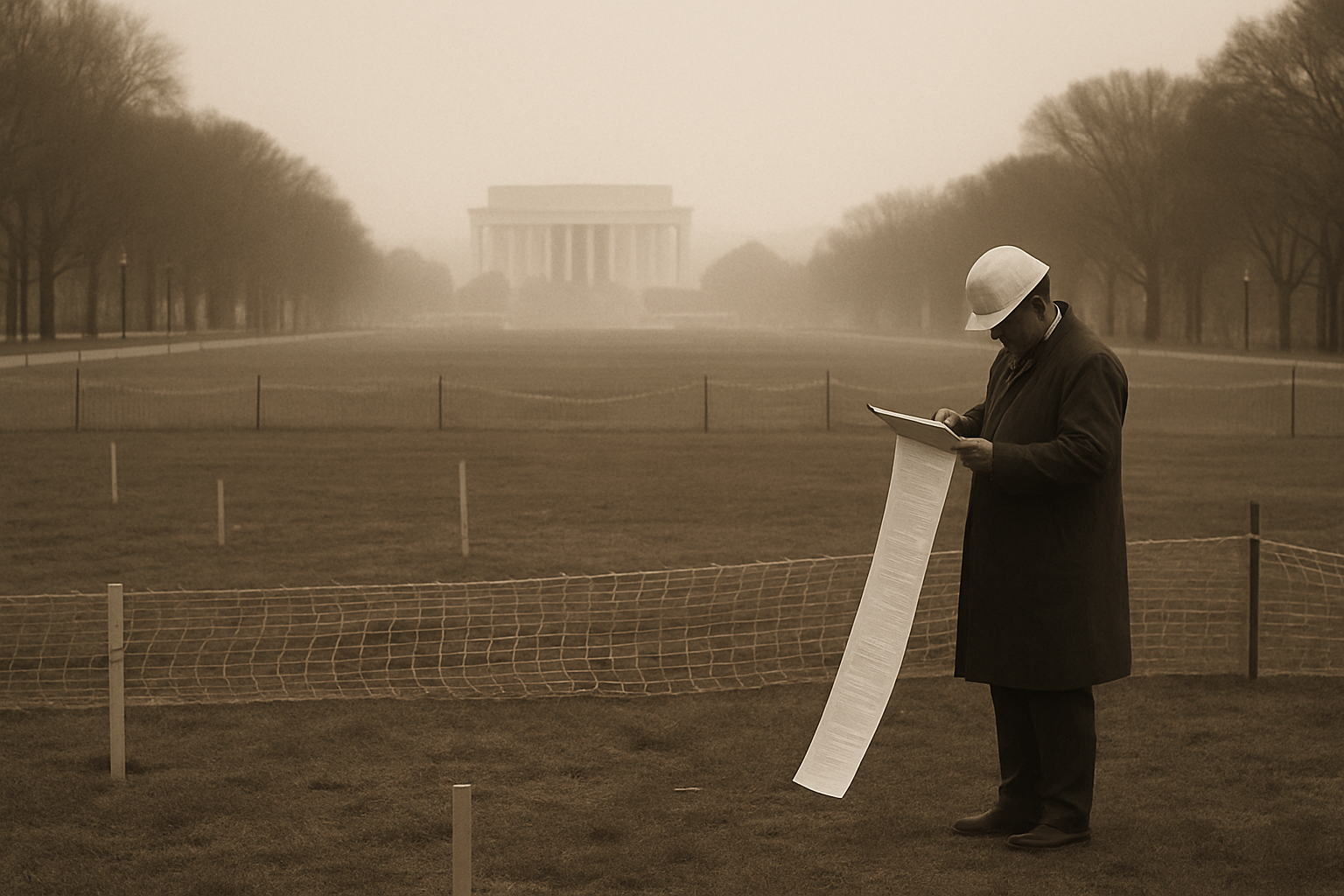
The White House announced this week a sweeping plan to honor 250 of America's greatest legends by constructing larger-than-life statues on the National Mall, describing the project as "a tribute to the rule of law and the enduring principles of the American Republic," before proceeding to violate several of them. The initiative, known as the National Garden of American Heroes, would feature bronze and marble likenesses of figures ranging from Founding Fathers to athletes to, reportedly, at least one individual whose primary claim to American heroism remains a subject of active interdepartmental debate.
Federal law, specifically the Commemorative Works Act of 1986, requires that any permanent monument on the National Mall receive approval from both Congress and the National Capital Planning Commission, a process that typically spans years and involves public comment periods, environmental reviews, and the kind of interagency coordination that burns through calendars the way statues burn through appropriations budgets. The administration's timeline, sources familiar with the project confirmed, did not include any of these steps, which officials characterized as "a formality situation."
"The heroes didn't wait for permission to be heroic," said a spokesperson for the Bureau of Commemorative Urgency, a office which does not exist but whose press releases, sources note, are indistinguishable in tone from ones that do. "We are simply extending them the same courtesy." The spokesperson did not take follow-up questions, citing what they described as "an ongoing posture of momentum."
A lawsuit challenging the project was filed in federal court shortly after the announcement, alleging that the executive order authorizing the garden bypassed Congressional authority, circumvented the planning commission, and in at least three instances designated park land that is technically still occupied by other things. The plaintiffs, a coalition of preservation organizations, noted in their filing that one of the proposed statue sites sits within twenty feet of an existing statue, raising the prospect of a hero adjacency conflict that legal scholars describe as "novel."
Historians consulted by this publication pointed out that the Commemorative Works Act contains a provision — verified, unembellished, and genuinely on the books — prohibiting any new commemorative work from being placed on the Mall itself, reserving that corridor as a "substantially completed work of civic art." This means the project, if constructed as planned, would be illegal not merely in process but in geography, a distinction officials acknowledged by not acknowledging it in any public statement reviewed for this article.
Of the 250 figures selected for commemoration, the majority are unambiguously American by any reasonable standard. A smaller subset prompted inquiries from the Bureau of Historical Residency Status, another nonexistent office whose workload, insiders suggest, has expanded considerably since January. At least one honoree was born in a country that did not yet exist when they were born in it, a condition historians describe as "common" and statue-selection committees describe as "fine, probably."
Construction firms contacted about the project declined to comment, citing pending litigation. The National Capital Planning Commission declined to comment, citing the fact that it had not been contacted. Congress declined to comment in the sense that it had not been asked, though several members commented anyway, using language that the Bureau of Printable Quotations has elected not to reproduce here in the interest of remaining a family publication about government dysfunction.
The garden, if completed, would be the largest commemorative installation on the National Mall since the World War II Memorial, which took twelve years, four lawsuits, and an act of Congress to build — a timeline the current administration has described as, and this is a direct quote, "a little excessive." Ground has not yet been broken. The survey stakes, however, are in.