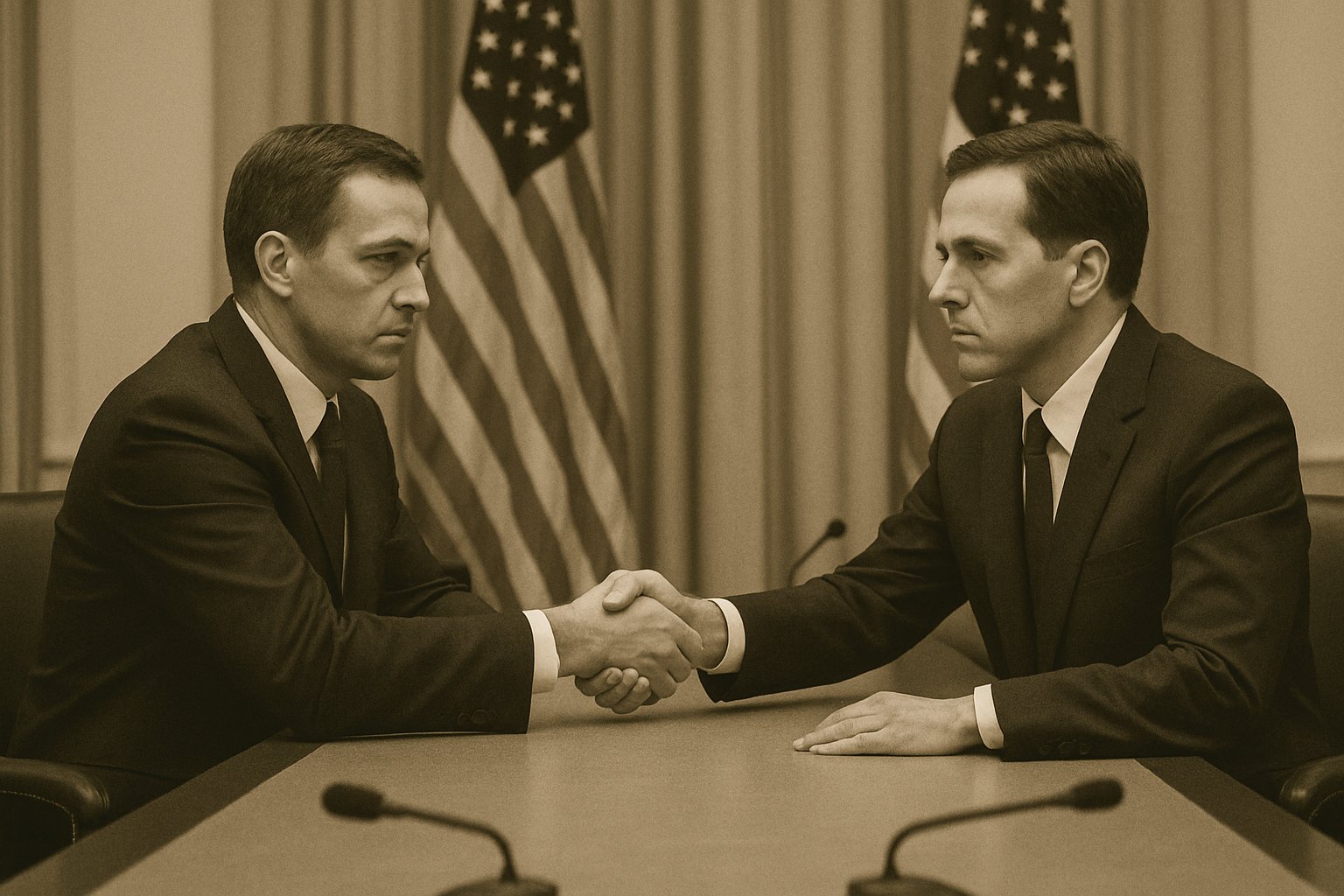
President Trump announced a breakthrough settlement agreement Tuesday, resolving a contentious $10 billion lawsuit against the Internal Revenue Service through what White House officials described as "masterful bilateral negotiations" between the President and himself.
The settlement, which establishes a $1.8 billion "lawfare victim compensation fund," concluded after what sources described as grueling back-and-forth discussions in the Oval Office. "Both parties came to the table with strong positions," said Acting Attorney General Todd Blanche, who previously served as Trump's personal attorney. "The President's ability to see both sides of this complex legal dispute really shows his range as a negotiator."
According to the Bureau of Self-Arbitrated Settlements, the talks nearly collapsed twice when the President-as-plaintiff rejected initial offers from the President-as-defendant. "There were some heated moments," confirmed an unnamed administration official. "At one point, he stormed out on himself. But ultimately, his commitment to finding common ground with his own interests prevailed."
The settlement fund will compensate individuals who claim to have been targeted by "weaponized government agencies," with the President serving as both the primary beneficiary and the official authorizing the payments. Treasury Secretary Scott Bessent praised the arrangement as "fiscally innovative," noting that the government simultaneously saves money by not paying the full $10 billion while also generating goodwill by establishing the compensation program.
Legal experts expressed amazement at the President's negotiating prowess. "In thirty years of watching federal litigation, I've never seen someone achieve such favorable terms against such a formidable opponent," said Professor Janet Morrison of Georgetown Law. The American Bar Association's Committee on Executive Self-Representation called the settlement "unprecedented in its efficiency."
The deal includes unusual provisions requiring the President to issue a formal apology to himself for any inconvenience caused by the lawsuit, while also accepting his own apology "in the spirit of moving forward." White House Counsel Will Scharf described the mutual forgiveness clause as "emotionally healing for all parties involved."
Under the agreement, the IRS will establish new protocols for handling future disputes involving presidential tax matters, including a mandatory 72-hour cooling-off period before any enforcement actions. The Bureau of Internal Conflict Resolution will oversee implementation, ensuring that all self-negotiations meet federal standards for impartiality.
The President celebrated the resolution during a brief Rose Garden ceremony, where he thanked himself for his reasonable approach to the discussions and promised to remain available for future diplomatic consultations as needed.