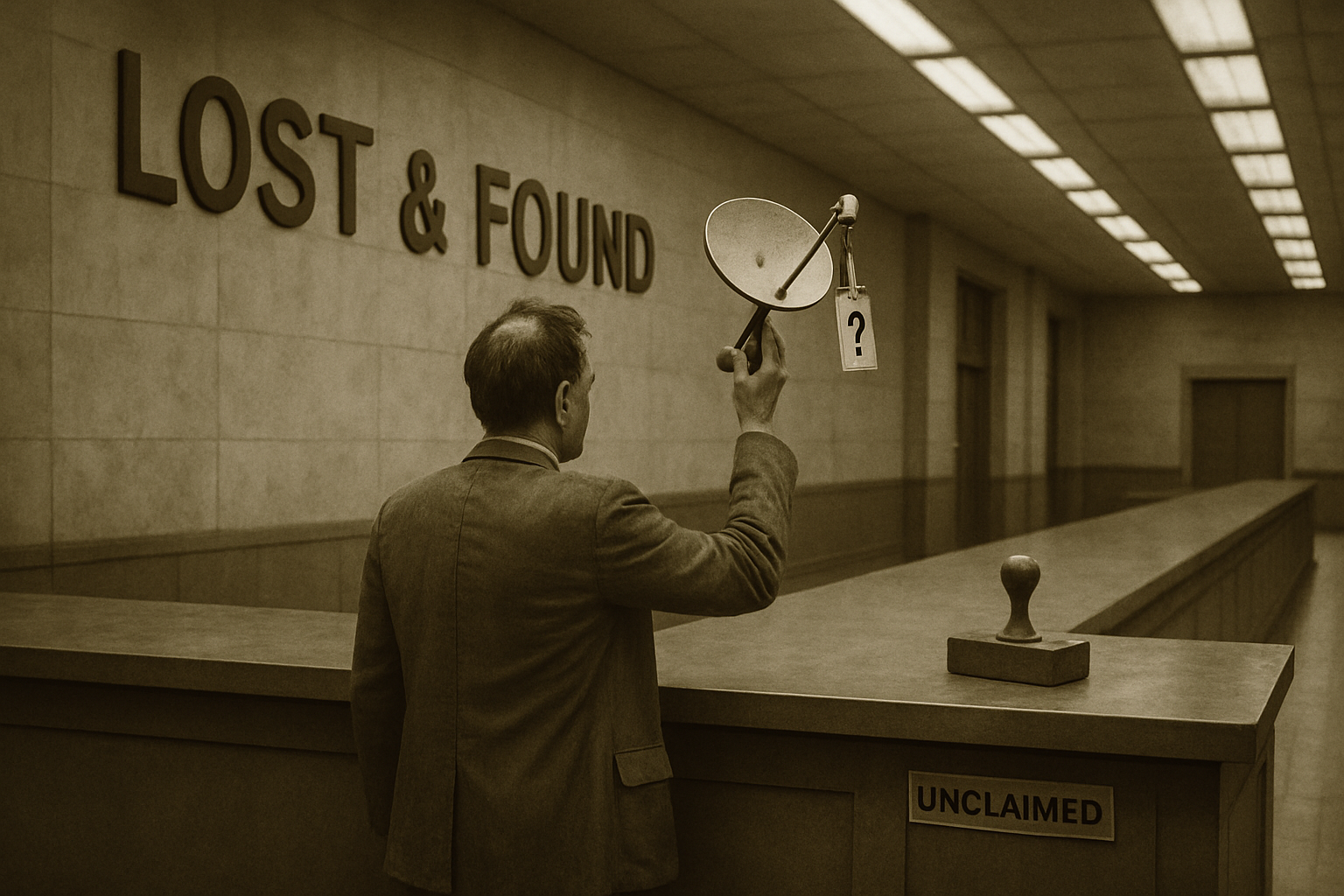
WASHINGTON — Federal authorities confirmed Tuesday that a foreign policy decision of significant geopolitical consequence has gone unclaimed at the front desk of the United States government, and asked that whoever is responsible please come forward at their earliest convenience, as the item has been sitting there for several weeks and is starting to affect the outcome of a land war in Europe.
The decision in question — a throttling of Starlink satellite internet service over active Ukrainian combat zones, which defense analysts say materially degraded the coordination of Ukrainian drone operations against Russian forces — was discovered in the Lost & Found sometime in early autumn, tagged only with a small card reading "not mine" in two different handwritings. Authorities say the card was signed, but that the signatures are "unclear at this time."
"The President has indicated he did not order the slowdown," said a spokesperson for a bureau that asked not to be named in connection with a bureau. "The owner of the satellite network has indicated the decision belongs to the government. The government has indicated the decision belongs to the owner of the satellite network. At this point we are simply asking that whoever's this is please come claim it, as we are running out of shelf space." The spokesperson added that the item would be donated to a third party if not collected within thirty days, though officials declined to specify which third party, or whether that party begins with the letter R.
Elon Musk, whose company SpaceX operates the Starlink network and who has previously acknowledged in a published biography that he personally intervened to disable Starlink access near Crimea in 2022 to prevent what he described as a Ukrainian surprise attack — this being the verified fact that requires no embellishment — told reporters this week that satellite coverage decisions of a military nature are ultimately the government's call. The government nodded slowly and said yes, absolutely, and then looked at the floor.
The Bureau of Unclaimed Geopolitical Consequences, which was established following a similar incident involving a no-fly zone nobody ordered in 2003, said the case presents unusual administrative challenges. "Normally when a major military infrastructure decision goes unclaimed, we can trace it back through the chain of command," said a senior official with the Bureau, speaking on condition of anonymity because the Bureau is also anonymous. "In this case the chain of command appears to be a circle, and we've been walking around it for several weeks."
Ukrainian drone operators, who do not have the luxury of not knowing what happened, reported measurable degradation in their ability to coordinate strikes during the relevant period. The drones themselves, according to one defense technology analyst, "functioned exactly as designed, given the signal they were given, which nobody gave them." Surviving units have been debriefed. Their testimony is consistent.
Officials stress that the situation should not be interpreted as evidence of any particular relationship between any particular individuals, and that the timing — in which satellite coverage in a war zone was reduced in a way that benefited one side of that war — is most likely what the Bureau of Temporal Coincidences formally classifies as "a temporal coincidence." The Bureau issued a statement to that effect, which was three pages long and contained the phrase "in no way" eleven times.
As of press time, the item remains on the counter. A small handwritten sign has been placed beside it reading "DOES THIS BELONG TO YOU?" No one has approached the desk. The fluorescent light above it, staff noted, has been flickering for some time, but a work order to fix it has not yet been submitted, as it is unclear whose responsibility that would be.