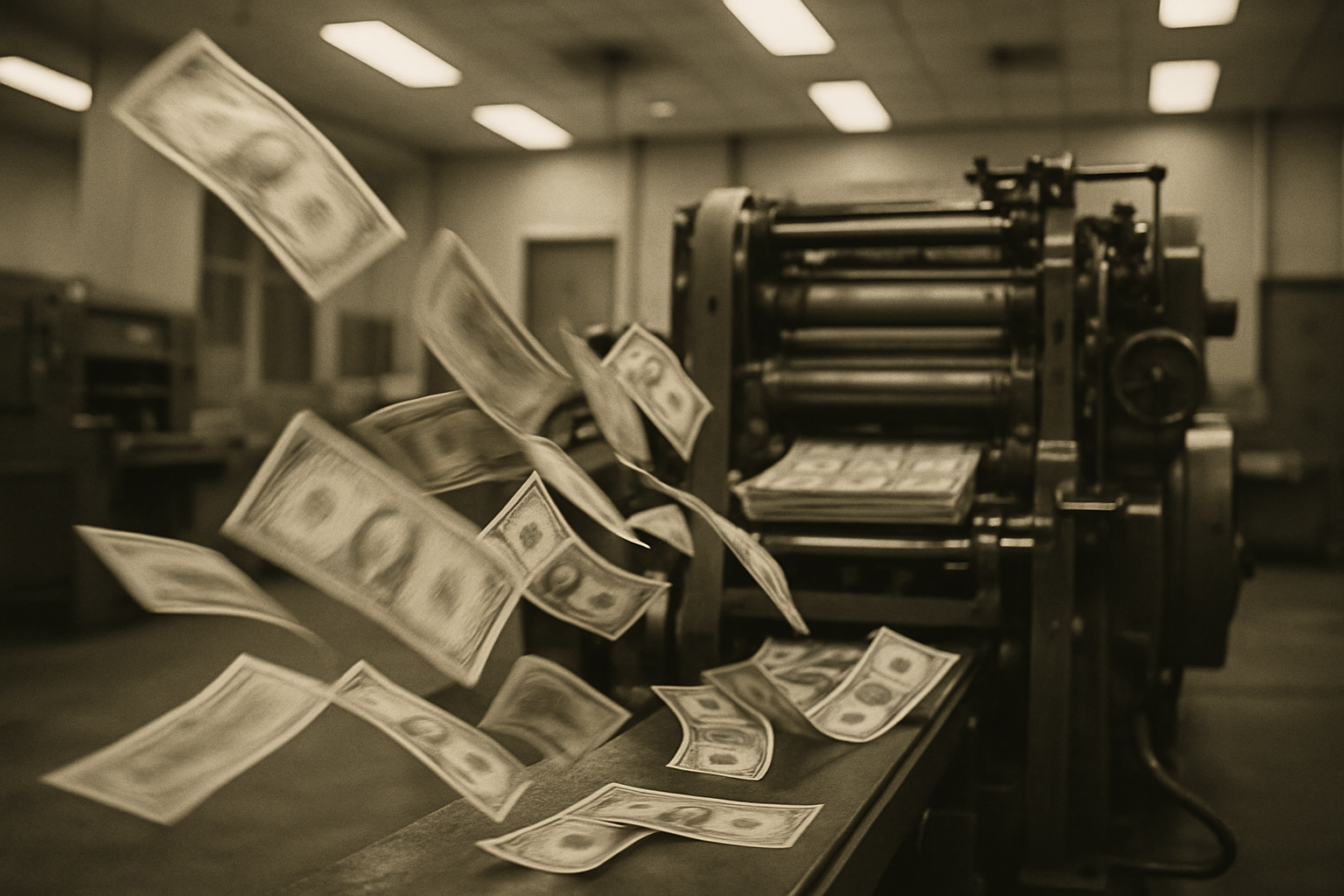
Treasury Secretary Scott Bessent became visibly agitated during a press briefing Tuesday when reporters questioned his department's ongoing development of a $250 bill featuring President Trump's portrait, despite federal law explicitly prohibiting living people from appearing on U.S. currency since 1866. "Please address me as Doctor Bessent," he said, adjusting his reading glasses. "And this is simply appropriate planning for future contingencies."
The Bureau of Engraving and Printing has reportedly completed seventeen prototype designs for the bill, which would violate Title 31 of the U.S. Code if it were ever produced. "We're not breaking any laws," Bessent insisted, holding up a sample bill that clearly showed Trump's face where Benjamin Franklin might normally appear on a hypothetical $250 denomination. "We're preparing for the possibility that Congress might change the law, which would then make this legal retroactively."
The controversy began when Treasury Department compliance officer Martha Rodriguez pointed out during a staff meeting that the project violated federal statute. Rodriguez was subsequently reassigned to the Bureau of Public Debt's filing division, where she now organizes receipts for paperclip purchases. "Martha raised some concerns about legal technicalities," said Deputy Treasury Spokesman Jim Walsh. "We felt her talents were better suited elsewhere."
According to internal documents, the $250 bill project has consumed approximately $2.3 million in research and development costs, including focus groups to determine the optimal shade of presidential orange for the portrait. The Bureau of Consumer Affairs conducted seventeen separate studies on public reaction to currency that doesn't exist, concluding that 34% of Americans would use the bill "if it were available and legal."
Federal law has prohibited living people from appearing on U.S. currency since President Andrew Johnson signed the legislation in 1866, following concerns about monarchical imagery. The law currently requires a person to be deceased for at least two years before consideration for currency placement. "That's just a guideline," Bessent explained, citing no legal precedent. "Besides, we're not actually printing money. We're printing prototypes of money."
The Treasury Department's Legal Affairs Division has reportedly been instructed to research whether prototype currency falls under different regulatory standards than actual currency. "It's like planning a hypothetical murder," said one unnamed official. "You're not actually committing a crime until you do the thing, and we're not doing the thing. We're just preparing to potentially do the thing if it becomes legal to do the thing."
Congressional Republicans have praised the Treasury's forward-thinking approach, while Democrats questioned the fiscal responsibility of spending millions on currency that cannot legally exist. The Government Accountability Office noted that the last time a new denomination was seriously considered was in 1969, when the $500, $1,000, $5,000, and $10,000 bills were discontinued due to lack of public use.
Bessent concluded the briefing by announcing that the department would continue its "preliminary preparations" while awaiting potential legislative changes. The sample bills remain locked in a Treasury vault, technically making them the most valuable worthless currency in American history.