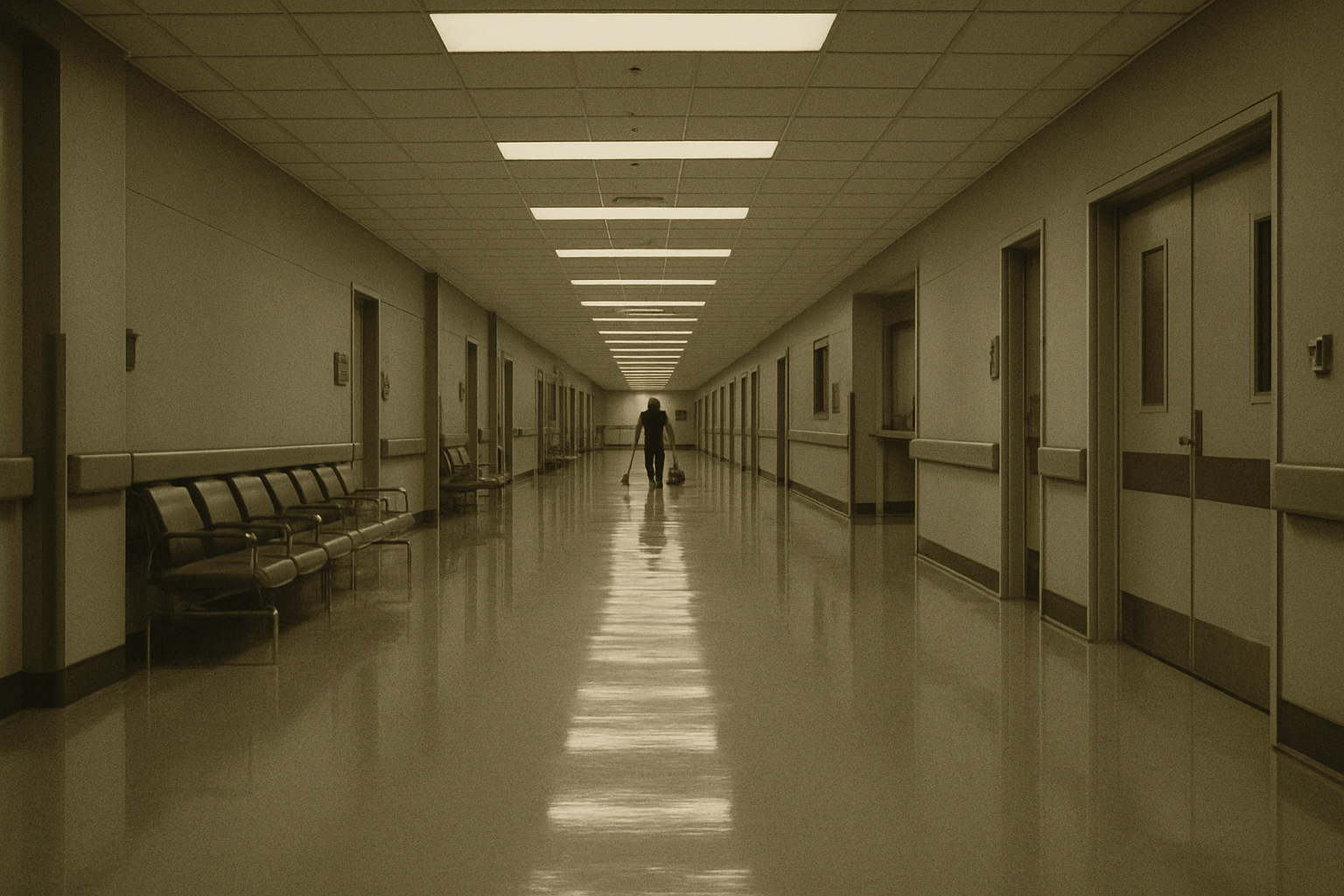
FREDERICKSBURG, VA — The Department of Veterans Affairs officially declared victory last Tuesday over the longstanding national challenge of constructing a very large building, confirming that the $300 million Fredericksburg VA Medical Center now stands complete at 470,000 square feet, which is, by any meaningful architectural measure, quite a lot of square feet. Officials at the ribbon-cutting ceremony described the facility as "the nation's largest VA health care clinic," a designation that remains technically accurate and will continue to be accurate regardless of how many physicians are inside it, which is currently a number best described as "fewer than intended."
The Bureau of Facility Completion, which does not formally exist but spiritually governs most federal construction projects, confirmed that the hard work is now finished. The building has walls. The walls have paint. The paint is the calming, restorative shade of institutional beige that medical professionals have long identified as "fine." Loading docks are operational. The parking lot, which sources describe as "genuinely impressive," can accommodate hundreds of vehicles belonging to patients who, upon arriving, will be directed to a facility with adequate square footage in which to wait.
Eighteen months after opening, veterans using the Fredericksburg clinic report an experience that one patient described to CNN as "walking through a cruise ship that doesn't have a crew." Long corridors connect spacious, fully equipped examination rooms that sit empty for significant portions of the day. Urgent-care wait times routinely stretch beyond two hours in a building whose primary therapeutic achievement, at present, is the opportunity to sit in a new chair while doing so. The VA has acknowledged a staffing shortage. The building has not acknowledged anything, as it is a building.
"We solved the infrastructure problem," said an unnamed senior official who asked not to be identified because he is currently working on the doctor problem. "That was the hard part. Everyone agreed the hard part was building it." When asked whether the hard part was perhaps staffing a medical facility with medical staff so that it could perform medical functions, the official indicated that this question had been raised internally and that a subcommittee had been formed to explore whether it was, in fact, the same hard part or a different hard part entirely.
The VA's staffing challenges are, by the department's own accounting, significant. The Fredericksburg facility is one of dozens of newly constructed VA health centers facing comparable shortfalls. Here the article is obligated to note, per its commitment to verified facts funnier than anything invented, that the VA currently employs more than 460,000 people, making it the second-largest employer in the United States federal government, trailing only the Department of Defense — a fact that has thus far failed to translate into anyone being available on Tuesdays at the Fredericksburg urgent-care desk.
Recruitment efforts have been described by the Bureau of Human Capital Attraction as "ongoing and robust," with the VA posting competitive salaries, federal benefits packages, and listings on job boards that any interested physician may locate by searching "VA physician jobs Fredericksburg" and then clicking through a federal hiring portal that requires the creation of an account, the verification of the account, the completion of a preliminary eligibility questionnaire, and a follow-up email that sources say sometimes arrives. Several positions have been open since the building was new, which was also when the building was empty, and is now when the building is still largely empty but with more scuff marks near the entrance.
Veterans' advocacy groups have noted that the Fredericksburg clinic represents, at minimum, a commitment to the concept of veteran health care as a physical location. "They built it," said a spokesperson for one such organization, who then paused for a long moment in a way that conveyed everything. The VA, for its part, says it remains focused on improving access, hiring timelines, and what one internal document referred to as "the translation of built capacity into delivered care," which is the government's preferred term for the thing a hospital is supposed to do.
A grand opening ceremony is reportedly still being planned for the day the clinic achieves full staffing. The parking lot will be ready.