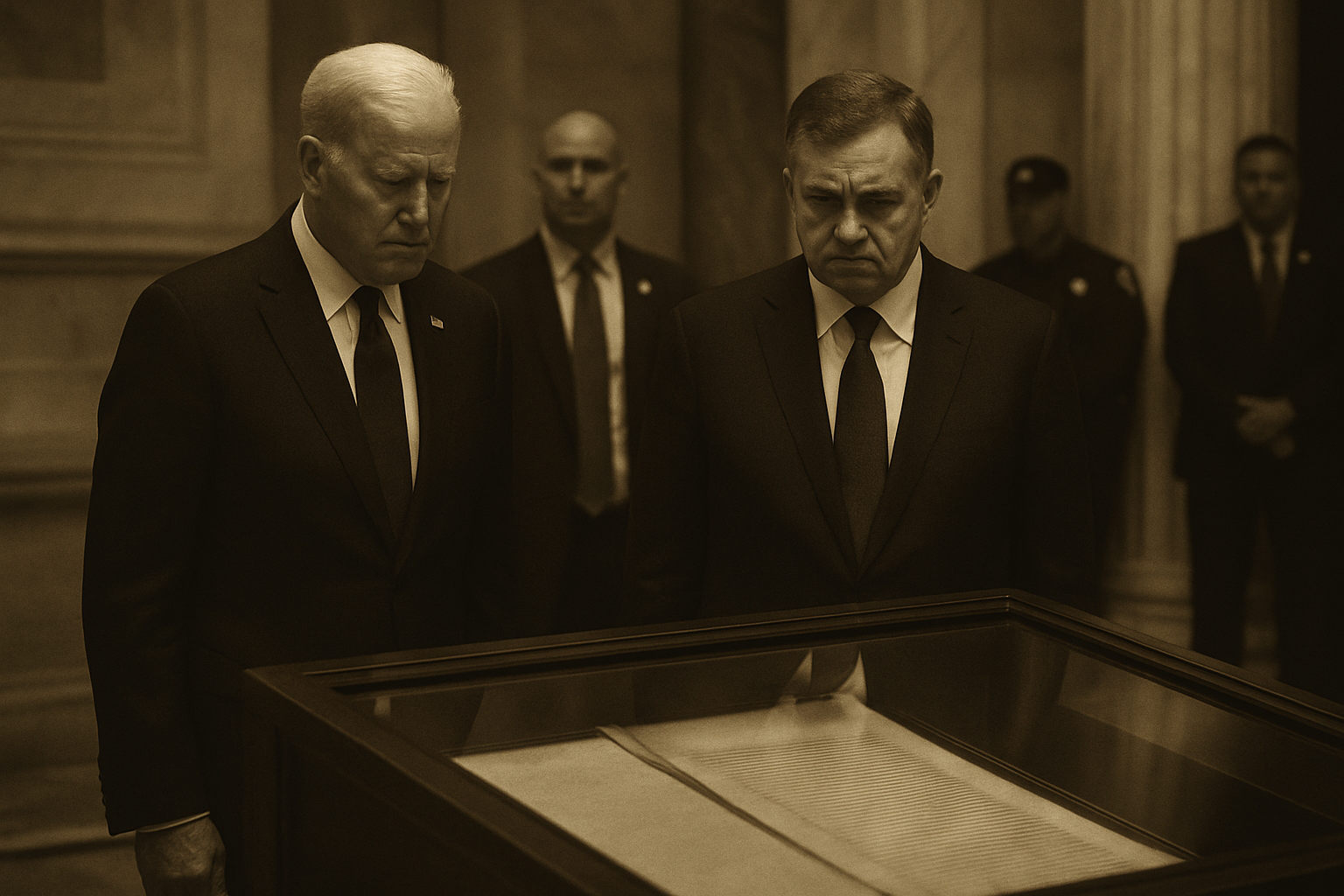
WASHINGTON — President Trump concluded three days of high-level diplomatic engagement with Chinese President Xi Jinping on Thursday by escorting him through the National Archives to view the Declaration of Independence, the Constitution, and the Bill of Rights, in what administration officials described as a "natural capstone" to talks that produced no joint statement, no signed agreements, and no announced breakthroughs of any kind.
The visit was conducted with full ceremonial honors. Archivists dimmed the lights to the appropriate reverent level. Security personnel maintained their positions. The documents, which include written prohibitions on unreasonable search and seizure, guarantees of free assembly, and protections for the press, were displayed under climate-controlled glass and did not address their audience directly.
Xi Jinping, who governs a nation where the Communist Party maintains a dedicated department for suppressing the previous sentence, observed the exhibits for several minutes. The Bureau of Diplomatic Atmospherics confirmed the mood was "solemn and productive." A readout of what either leader said while standing before the First Amendment was not made available to the press, several members of which were waiting outside.
Analysts who had spent three days describing the summit as "heavy on pomp and light on substance" were offered no reason to revise their assessment. Trade tensions, Taiwan, fentanyl, semiconductor export controls, and the South China Sea were all subjects that sources familiar with the discussions confirmed had been discussed, in the sense that they had been present in the room as concepts.
According to the National Archives, the Charters of Freedom — the collective name for the documents displayed — are visited by approximately 1.2 million people each year, most of whom are American schoolchildren and foreign tourists. Thursday marked what archivists believe to be the first time the collection has been toured by the sitting leader of a nation that blocks its citizens from accessing Wikipedia's article about Tiananmen Square, though they noted they do not typically track this specific demographic.
The White House characterized the Archives visit as an opportunity for President Xi to "experience American history firsthand." A spokesperson for the Chinese delegation did not respond to questions about which amendment Xi found most thought-provoking, or whether the Fifth — which protects individuals from being compelled to testify against themselves — had prompted any personal reflection.
Officials from both governments noted that the summit had significantly advanced what they called "bilateral dialogue," a phrase that was used eleven times in public statements and defined by neither party. A senior administration official, speaking on condition of anonymity because they were not authorized to describe the tour out loud, said the visit to the Archives was "purely cultural" in nature and should not be interpreted as a message of any kind, to anyone, about anything.
The documents were returned to their cases following the visit. They are expected to remain there.