WASHINGTON — The United States of America turned 250 years old this week, marking the occasion in the traditional fashion: a federal commission, a rival LLC, and a wire transfer that allegedly went somewhere other than where it was supposed to go, which experts note is also how the Continental Army handled its payroll.
Congress established America250 in 2016 as the official bipartisan commission charged with planning the nation's semiquincentennial celebration, granting it the full weight of federal legitimacy, a board of directors, and the implicit assumption that organizations with nearly identical names would not subsequently materialize and begin accepting donations. That assumption proved optimistic. A separate entity called Freedom 250 emerged in the intervening years, and House Democrats have since accused the Trump administration of "hijacking" the official birthday apparatus in favor of the newer, less congressionally authorized one — a charge Freedom 250 has dismissed as a partisan smear, which is also what the British called the Declaration of Independence.
"The integrity of the semiquincentennial donor pipeline is of paramount concern to this Bureau," said a spokesperson for the Bureau of Commemorative Financial Instruments, an office that does not exist but whose absence from the federal register is, in retrospect, part of the problem. Donors who believed they were wiring funds to the congressionally chartered commission reportedly received account information that directed their contributions elsewhere, a development described by one unnamed official as "an administrative irregularity consistent with the broader spirit of American enterprise."
The verified fact at the center of this pageant, funnier than anything a satirist could responsibly invent, is that Congress created a birthday commission a decade in advance and still managed to lose track of the birthday money. The commission had ten years. The birthday was not moved. The date, July 4th, has been consistent since 1776, with limited exceptions for federal holidays falling on weekends, which are handled by a separate office.
Freedom 250 has maintained that its celebrations represent the authentic expression of American patriotism and that any suggestion to the contrary reflects a fundamental misunderstanding of both patriotism and wire transfers. America250, the original commission, has continued operating in what sources describe as "an atmosphere of dignified procedural distress." Both organizations agree that America is 250 years old. This remains the only point of consensus between them, and even that, officials cautioned, should be considered preliminary pending audit.
Historians reached for comment noted that the United States has a well-documented tradition of funding its own celebrations through mechanisms that later require congressional investigation, pointing to the Centennial Exposition of 1876, which went over budget, and the Bicentennial of 1976, which produced an official logo so aggressively mediocre that it has since been studied in graduate programs. "Two hundred and fifty years of self-governance has produced, among other things, a robust ecosystem of self-governance-adjacent revenue capture," said a professor who asked not to be named because she is up for tenure and this is not the kind of quote that helps.
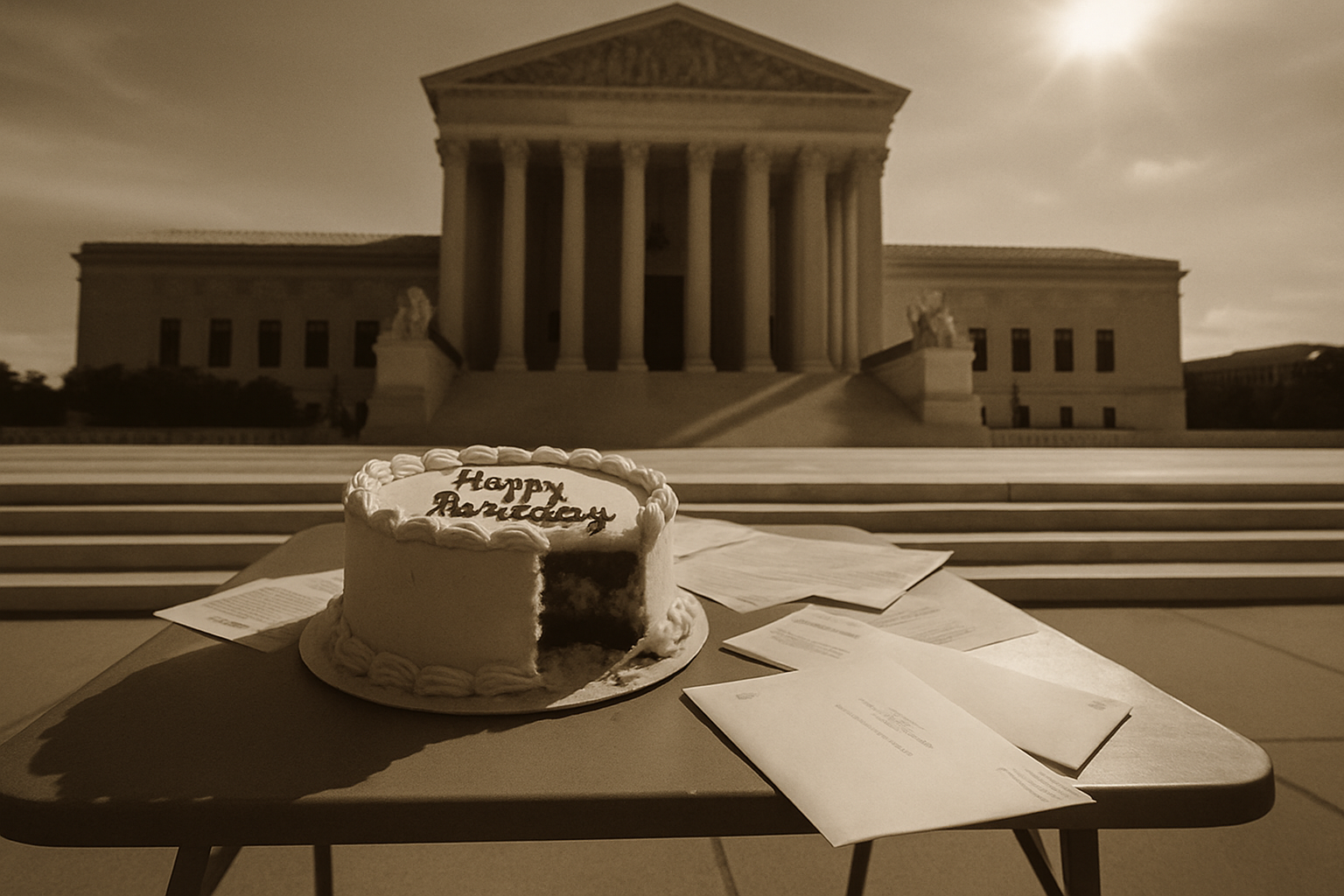
The birthday cake, by all accounts, remains partially uneaten. It was baked for one celebration and delivered, sources allege, adjacent to another. Photographs reviewed by this publication show a sheet cake of standard federal proportions, frosted in red, white, and blue, bearing the inscription "250 — America!" in a font that procurement records indicate cost $4,200 to license. Whether the cake was cut, and by whom, and under which commission's authority, is the subject of ongoing review by at least two subcommittees, one of which was itself established by a commission.
Fireworks proceeded as scheduled. The nation, by most accounts, did not notice the difference, which is perhaps the most patriotic outcome available.