WASHINGTON — President Trump announced Monday that he would decline to sign the most bipartisan housing legislation in three decades, a bill that passed the House 358-32 and the Senate 85-5, on the grounds that a separate, unrelated bill had not yet passed, marking what constitutional scholars are describing as "the first known instance of a president attempting to veto a win."
The Federal Bureau of Legislative Outcomes confirmed that the unsigned bill will automatically become law in ten days regardless of presidential action, a procedural reality the administration has characterized as "a partial victory at best, and frankly a little suspicious."
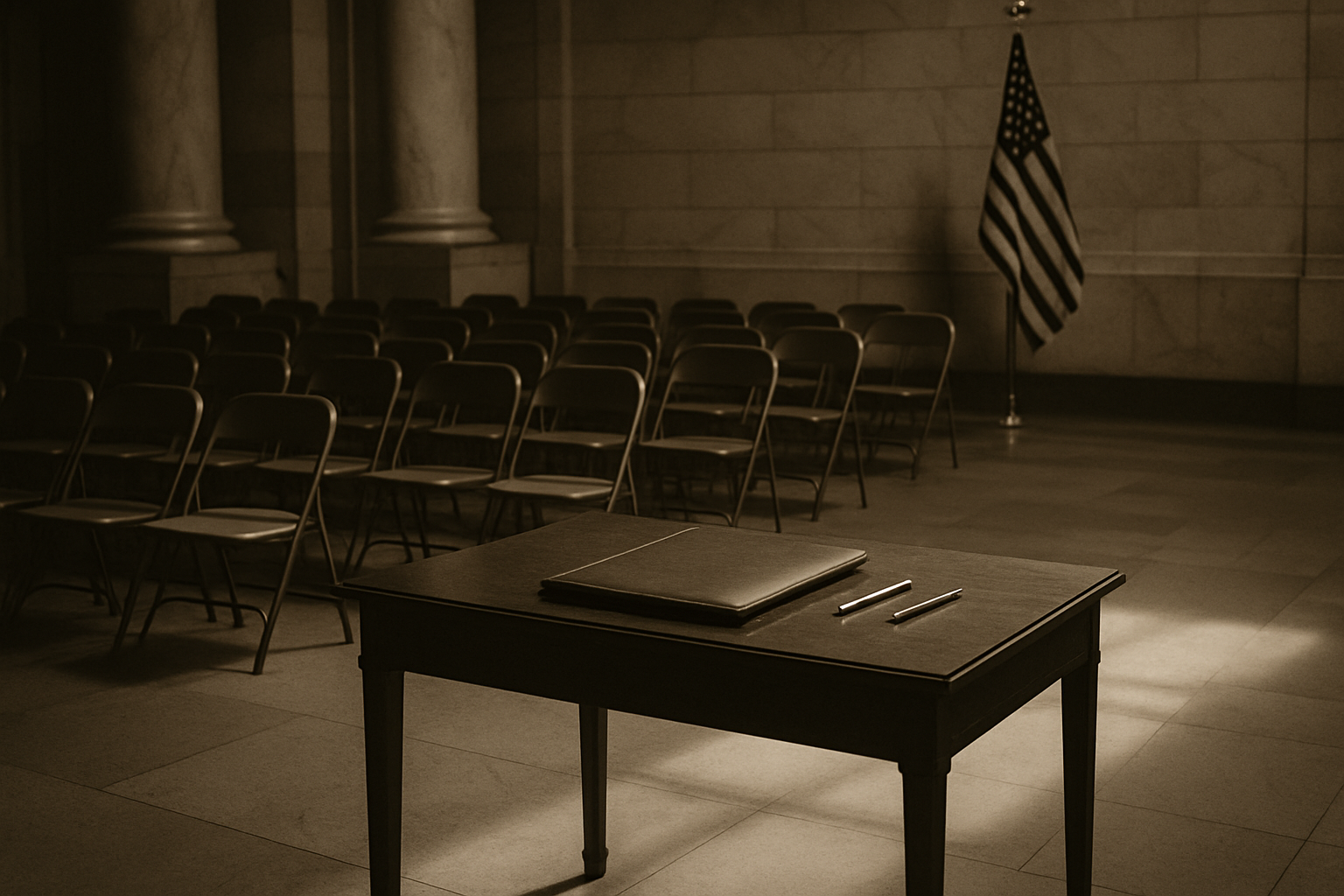
The signing ceremony, scheduled for 2 p.m. in the East Room, had already drawn a bipartisan crowd of legislators, housing advocates, and at least three senators who had never previously agreed on the location of a drinking fountain. Folding chairs were arranged. Pens were laid out. A leather-bound folder containing the bill sat on the ceremonial table. At approximately 11:47 a.m., the White House issued a statement indicating that the event would not proceed until Congress demonstrated "full support" for the SAVE America Act, a separate piece of legislation that had, at that point, passed neither chamber.
Officials speaking on condition of anonymity, because they were still processing what had happened, noted that the 358 House members who voted for the housing bill represent approximately 82 percent of the entire chamber — a margin that, per the Bureau of Parliamentary Arithmetic, is "technically more than enough to override a veto, should one somehow be issued against a bill the president supports."
The White House declined to address this arithmetic directly but released a statement praising the president's "strategic patience" and his "refusal to accept incremental progress when total and complete progress remains theoretically achievable." A senior administration official added that the president was "very proud of the bill" and looked forward to not signing it "in a powerful way."
Historians reached for comment noted that while presidents have occasionally delayed signing ceremonies for political effect, no previous executive had deployed a bill he supported, passed by margins that rendered his own position irrelevant, as leverage for an unrelated legislative demand. "It's a hostage situation," said one scholar, "in which the hostage is also the ransom, and the kidnapper is rooting for the hostage." The scholar then excused himself to lie down.
The housing bill in question, which addresses affordable housing development and zoning reform, received support from the National Association of Realtors, the AFL-CIO, the United States Conference of Mayors, and at least one senator who described the legislation as "the most obvious thing we've done in years." Per the Bureau of Overlooked Ironies, it is also worth noting that the bill contains provisions the president himself proposed in a February policy memo, a document the White House has not disavowed but has declined to remember.
The bill is expected to become law on or around the 10th day following congressional passage, at which point it will take effect without a signature, without a ceremony, and without the traditional photograph of the president holding up the pen. The affordable housing it funds will, according to projections, begin construction regardless. The folding chairs have been returned to storage.