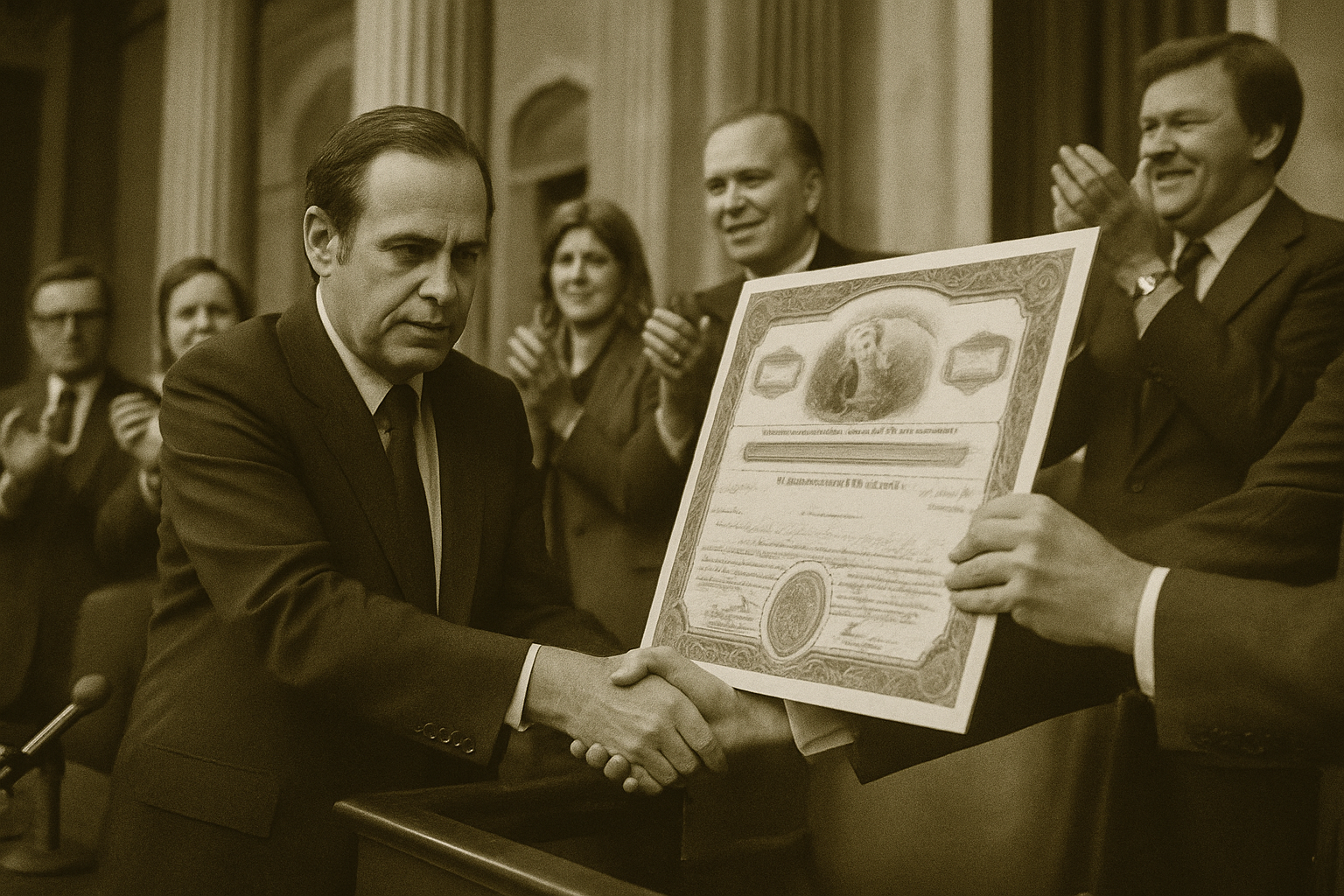
WASHINGTON — In what the Bureau of Legislative Self-Improvement called "a watershed moment for the rule of law, the principle of accountability, and the general concept of barn doors," the House of Representatives passed the Stop Insider Trading Act on Wednesday by a vote of 232 to 198, permanently prohibiting members of Congress from purchasing individual stocks they do not already own, have never tried to own, and would not have been able to afford to own given the particular legislative schedules that prevented them from purchasing additional shares prior to this vote.
"Today, we draw a line," said a senior House sponsor at a press conference, gesturing broadly toward a line that had been drawn approximately six portfolio diversification strategies behind where every member of Congress currently stood. "The American people demanded action. We heard them. We acted. What they do with that information is, frankly, up to them and their financial advisors."
The legislation, which sponsors described as "transformational," "historic," and "the culmination of years of not doing this," closes a loophole in Congressional ethics law by ensuring that no member may henceforth benefit from purchasing stock based on nonpublic information — unless they have already purchased such stock, in which case the loophole remains fully operational, pressure-washed, and available for public tours on Tuesdays. Existing holdings are explicitly protected. The right to sell existing holdings at any time remains intact. The right to watch those holdings appreciate based on legislation members are currently drafting is, according to the Bureau of Statutory Ambiguity, "a matter of ongoing interpretive interest."
A provision exempting the President from the bill's restrictions was described by one unnamed senior official as "a technical necessity," "a drafting clarification," and, after a brief pause, "not something we're doing questions on." According to reporting by Fortune, President Trump executed approximately 3,600 trades in the first quarter of 2026 alone — a figure that House sponsors noted was "very impressive from a volume standpoint" before abruptly leaving the room.
The verified fact that members of Congress have, as a class, historically outperformed the S&P 500 by statistically improbable margins during periods when they were actively drafting legislation affecting specific industries was entered into the Congressional Record on Thursday under the category heading "Coincidences, Inspiring." A subcommittee has been formed to study the phenomenon. Its members have asked to be notified before any findings become public so that they may, in the words of a committee aide, "prepare appropriate remarks."
Critics of the bill argued that permitting members to retain existing holdings while prohibiting new purchases effectively rewards the most prolific traders in the chamber and penalizes any hypothetical future member who might arrive in Washington owning nothing — a constituent demographer the Bureau of Congressional Composition confirmed represents "an exciting theoretical category." Supporters of the bill countered that critics were "misunderstanding the spirit of the legislation," and then declined to describe the spirit of the legislation.
Under the new law, members found to have violated the prohibition on new purchases will face a fine of up to $50,000, which the Bureau of Comparative Returns noted is less than the average annual return generated by a Congressional portfolio in any year during which infrastructure, defense, pharmaceutical, or energy legislation was passed — a category that encompasses, by the Bureau's own accounting, every year on record.
The bill now moves to the Senate, where leadership has pledged to give it a thorough and deliberate review. As of press time, seventeen senators had purchased shares in companies that manufacture barn doors.