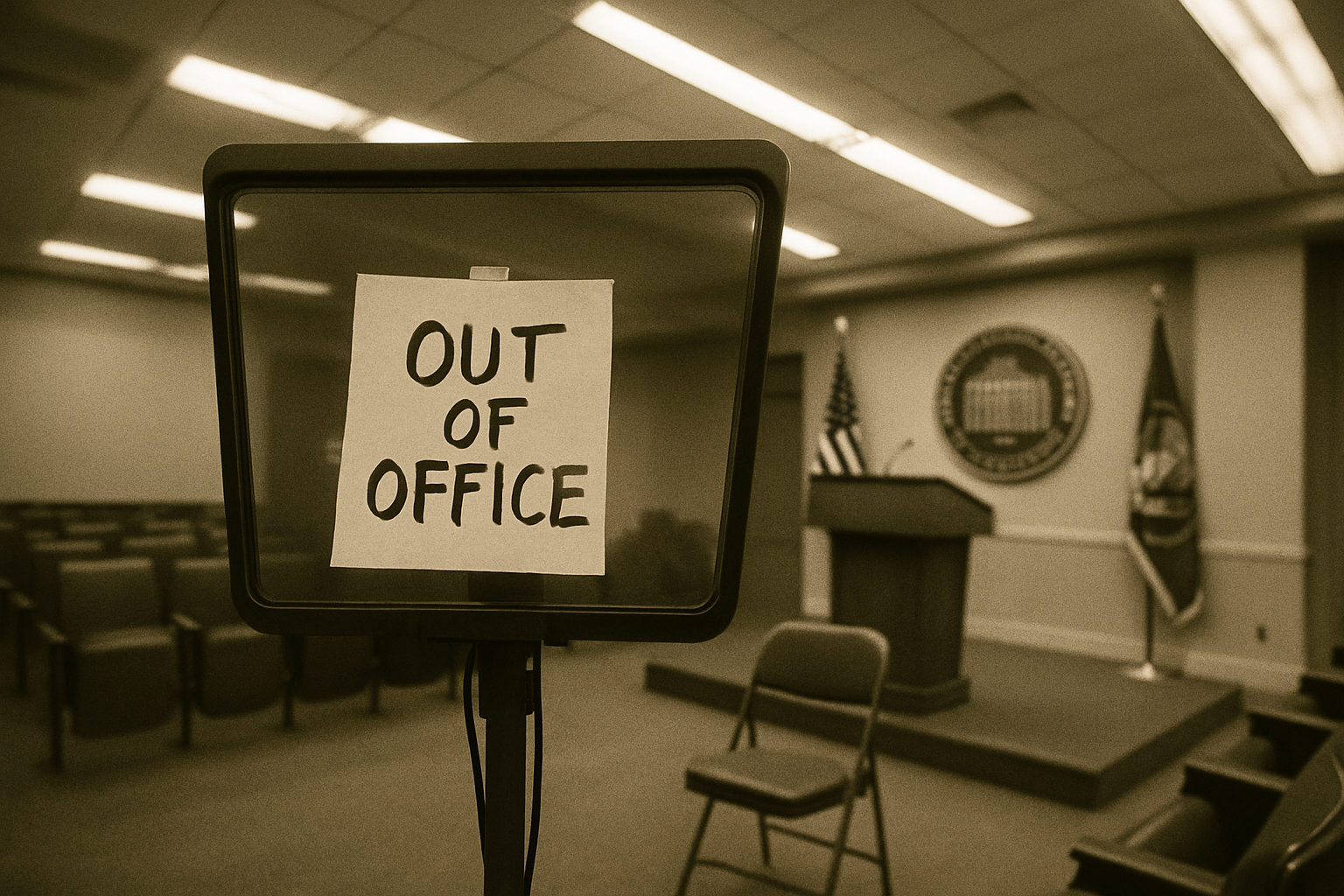
Federal regulators have suspended a White House teleprompter operator following allegations that he used advance knowledge of the president's prepared remarks to place profitable bets on a political prediction market, according to a Commodity Futures Trading Commission inquiry first reported by CNBC. The man, whose precise employment title the Bureau of Executive Lectern Operations declined to confirm or deny exists, was reportedly responsible for loading, scrolling, and displaying the words the president would then say out loud, in order, at a pace of the president's choosing.
Investigators allege the operator used this positional advantage — described in federal filings as "material non-public information regarding imminent presidential speech acts" — to place winning wagers on the prediction platform Kalshi, which allows users to bet on real-world outcomes including, apparently, the specific content of remarks delivered by the leader of the free world. The CFTC did not elaborate on why this market exists, as that question was deemed outside the scope of the investigation.
According to individuals familiar with the inquiry, the operator netted approximately $100,000 before Kalshi's fraud-detection algorithms flagged an anomaly: one account demonstrated a statistically improbable ability to predict, with near-certainty, what the president was about to say. Officials noted this is the same information the operator had been paid a government salary to possess, and to display, at eye level, in large scrolling text, directly in front of the president's face.
The case grew more complicated during at least one speech in which the president departed from his prepared text. Investigators allege the operator executed what one CFTC document describes as a "real-time hedge," adjusting his open positions mid-address as it became apparent the remarks were no longer tracking the document he had personally loaded forty minutes earlier. Whether this constitutes insider trading, extraordinary reflexes, or simply a thorough understanding of the president's rhetorical tendencies remains a matter of active legal debate.
"There is an expectation," said an unnamed White House official, "that individuals granted access to the president's words, before the president says those words, will not immediately convert that access into a revenue stream." The official acknowledged, when pressed, that this expectation had not previously been codified in any formal policy, ethics pledge, or employee onboarding document, because it had not previously seemed necessary to write down.
The prediction market industry, which has grown substantially since a 2024 federal court ruling expanded the legality of event-contract trading, has welcomed bets on elections, legislation, economic indicators, and, as this case confirms, the specific verbal output of individual American presidents. Kalshi, which processed the trades in question, cooperated fully with regulators and noted in a statement that the platform's terms of service do prohibit the use of "non-public information," a clause the company said it had assumed would be self-enforcing.
Legal scholars contacted by this publication noted that the case raises novel questions about the boundary between professional knowledge and insider advantage, particularly in roles where the entire professional responsibility is to know things before other people know them. "If your job is to read the script," said one law professor who asked not to be named, "and you bet on the script, and you win, the law has opinions about that. The law is still working out what those opinions are." He then asked to be quoted as someone else entirely.
The teleprompter has since been operated on an interim basis by a rotating pool of contractors who have each signed a newly drafted addendum prohibiting them from betting on the contents of any document they are actively displaying. The president, for his part, continued delivering remarks last week without apparent awareness that anything had changed, which observers noted was, in its own way, the most legally uncomplicated outcome available.