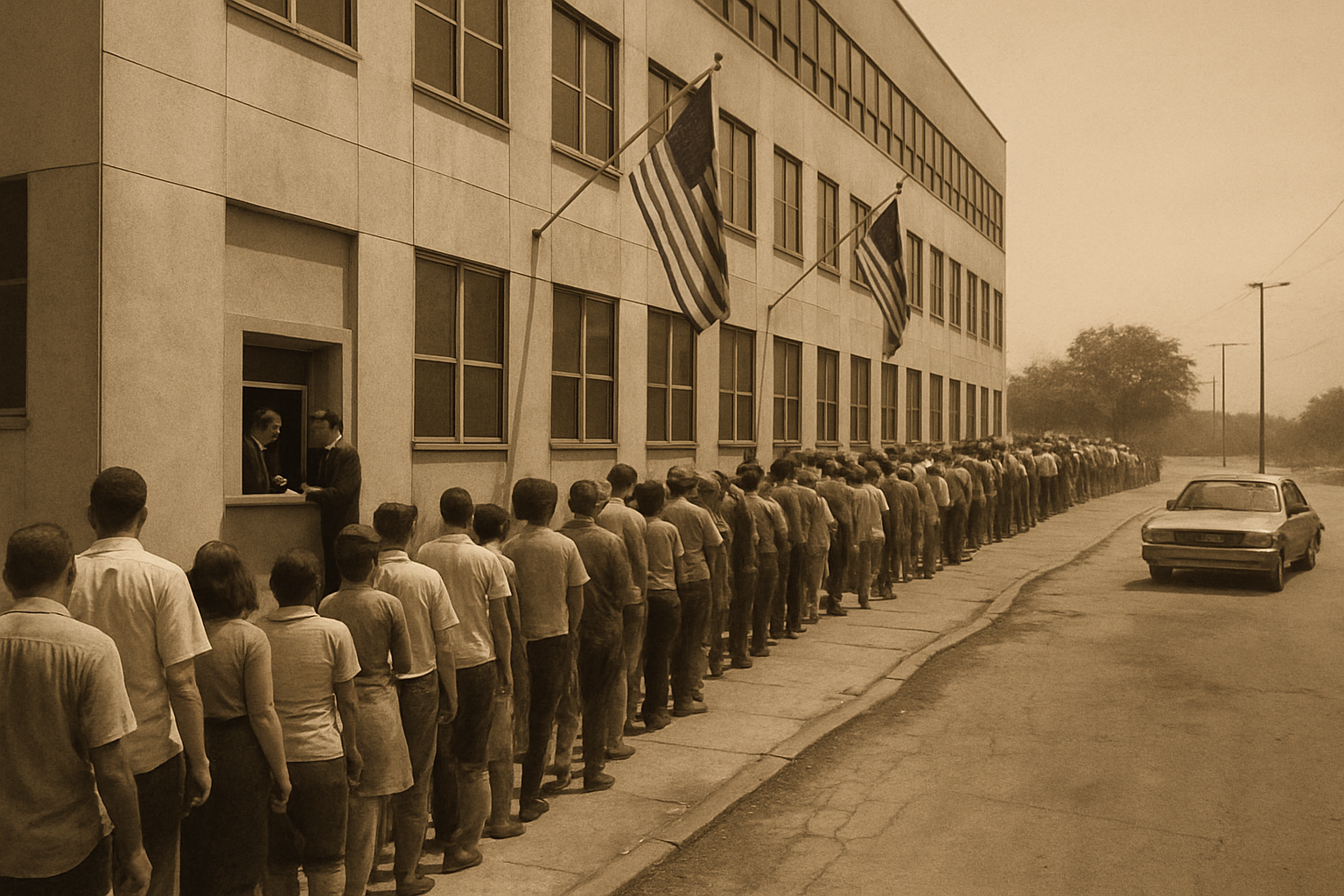
The United States government, long celebrated for its commitment to accessible public services, has unveiled what officials are calling a significant modernization of the passport system: a single office, located in Washington, D.C., open by appointment only, issuing travel documents bearing the portrait of President Donald J. Trump. Americans wishing to obtain one are encouraged to plan ahead, secure an appointment, and ideally live within a reasonable driving distance of the nation's capital, a city home to approximately 0.2 percent of the American population.
The rollout has been described by the Bureau of Consular Streamlining as "a model of intentional friction," offering citizens the rare opportunity to demonstrate their patriotism through the act of scheduling, traveling, and waiting. "We have eliminated the chaos of choice," one unnamed State Department official explained, adding that the office currently has appointment availability in the third week of September, for those who began planning in April.
Among the first to test the system's accessibility was a man from Alabama who drove approximately eleven hours to the Washington passport facility after failing to secure an online appointment through what he described as "a website that appeared to be load-bearing." Upon arrival, he was informed that walk-ins are not accepted, that his presence was technically unauthorized, and that he was welcome to return with an appointment, which he could request from the same website, from the parking lot, if he had a strong enough signal.
The commemorative passport, which features President Trump's image alongside patriotic imagery and what the State Department describes as "thematic interior artwork," is issued automatically to applicants who request a standard 28-page booklet. Americans who would prefer a passport without the president's portrait do have an option: they may request the 52-page version, a preference so non-default that it went largely unreported until a news investigation by NPR determined it existed. The Bureau of Document Aesthetics confirmed the opt-out is "technically visible" on the application form, in the sense that all text on the form is technically visible.
Officials were quick to note that the single-location model reflects a broader philosophy of concentrated excellence. "When you have one office," said a spokesperson for the Bureau of Geographic Efficiency, "you have one standard. You have one vision. You have one parking situation, which is admittedly complicated, but that's more of a D.C. issue." The spokesperson added that the office is accessible by Metro, bus, rideshare, or, as demonstrated, by personal vehicle from any of the contiguous 48 states, though the latter is not officially recommended.
Travel document historians note that the United States has previously issued passports featuring presidents' images in a limited commemorative capacity, though the current rollout represents the first time a sitting president's portrait has appeared on a standard-issue passport as the default option rather than an exception. This is, by any technical measure, a verified fact, which the Bureau of Historical Context acknowledges is doing a great deal of work on its own.
The State Department has faced questions about appointment availability, with current wait times ranging from several weeks to "it depends on how the website is feeling," according to one applicant who asked not to be named because she has to travel internationally in August and cannot emotionally afford to antagonize anyone at this time. Officials confirmed that additional appointment slots may become available, and that the best strategy is to check frequently, early in the morning, on multiple devices, while remaining flexible about one's definition of the word "available."
The man from Alabama, reached by phone from a rest stop outside Fredericksburg, Virginia, said he had rescheduled an appointment for late August and was "pretty sure" he could make it work around his work schedule. He noted that he did not have a strong opinion about whose face was on his passport. He just needed to get to his nephew's wedding in Portugal. He drove home.