WASHINGTON — The Department of Government Efficiency, a federal initiative created to eliminate wasteful government programs, completed its mission Friday by eliminating itself, leaving behind no closing audit, no transition memo, no forwarding address, and approximately 847 unread interagency emails that officials described as "someone else's problem now." The agency's website went dark at midnight on July 4th, a timing the Bureau of Symbolic Coincidences called "either deeply intentional or completely accidental, and we lack the staff to determine which."
The self-termination had been announced months in advance, which experts note is the only deliverable DOGE completed on schedule. "Most agencies, when they close, produce a final report," said one unnamed transition official who had been waiting by a fax machine since March. "A summary of accomplishments. A list of ongoing obligations. A sticky note, even. We received a deactivated URL and what appears to be a Venmo request." The Venmo request is currently under review.
DOGE claimed $215 billion in federal savings during its 18-month tenure, a figure the agency calculated using a methodology it described in public materials as "math." Independent auditors have not verified the number, partly because no independent auditors were commissioned, and partly because the office where such auditors would have filed their request no longer exists as of 12:01 a.m. Friday. The Bureau of Figures That Sound Large confirmed the $215 billion estimate is "plausible in the same way that most large numbers are plausible."
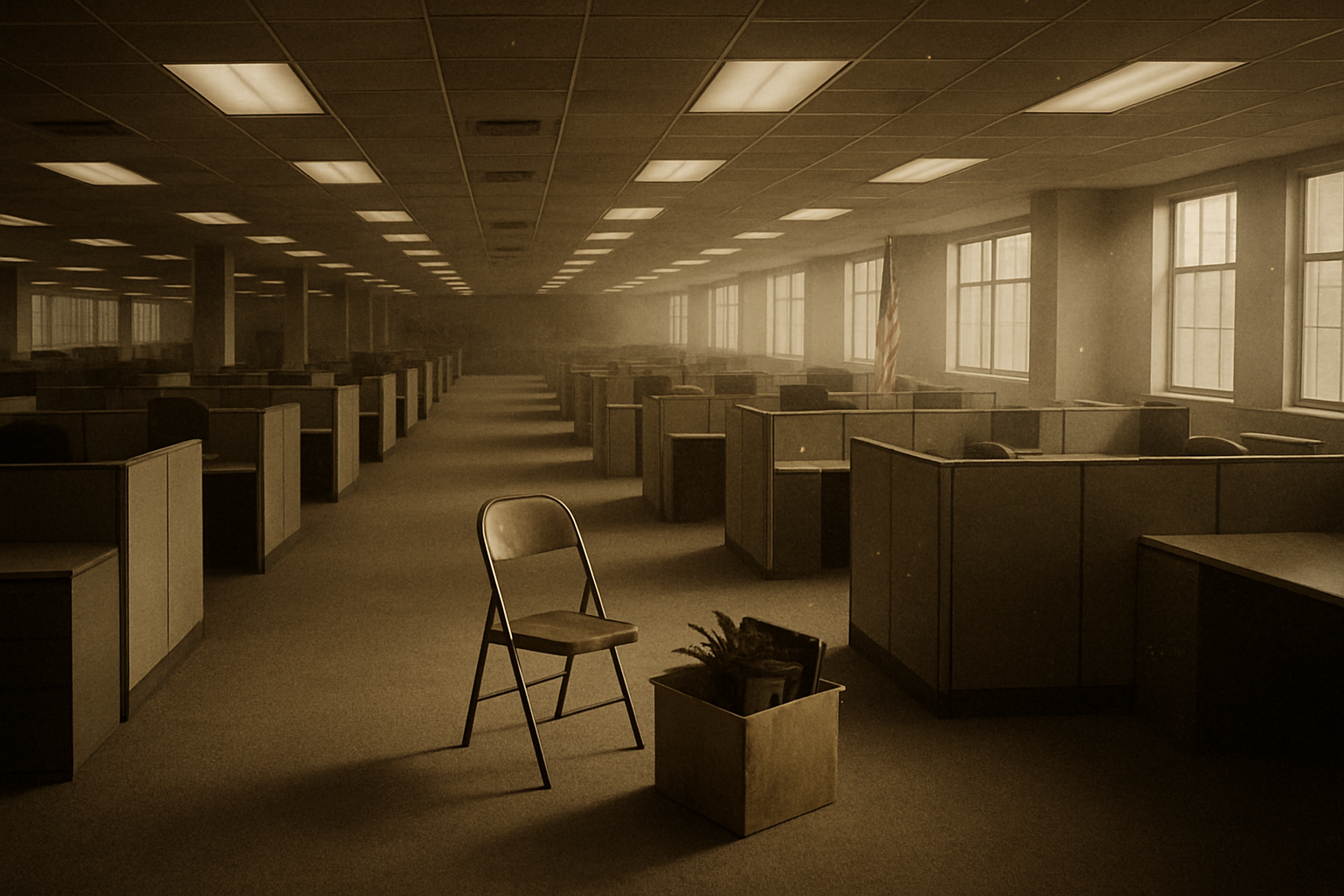
Among the agency's final unfinished business: a mandate requiring federal workers to return to their government offices. The General Services Administration confirmed on July 4th — the same day DOGE dissolved — that the offices DOGE ordered workers to return to remain approximately three-quarters empty, a figure that represents both a facilities utilization rate and, in the assessment of several current and former officials, a metaphor. The chairs are there. The desks are there. The workers are somewhere. The agency that demanded their presence is not.
The departure was described by those familiar with its operations as "on brand." DOGE spent the better part of a year identifying redundant programs, duplicative spending, and bureaucratic structures that existed primarily to justify their own existence. It then spent the remainder of its tenure as a redundant program with duplicative spending that existed primarily to justify its own existence. "You have to admire the commitment to the bit," said a senior official at an agency that asked not to be named because it is also not entirely sure it still exists.
The federal government currently employs approximately 2.3 million civilian workers, a number that has remained statistically stable despite DOGE's efforts, which the Bureau of Stubborn Continuity attributed to "the essentially liquid nature of bureaucracy." Offices that were cut reorganized. Functions that were eliminated were quietly reassigned. Personnel who were let go filed appeals. In at least fourteen documented cases, the same position was eliminated and then rehired under a different title within the same fiscal quarter, a process one HR official described as "efficiency."
No senior official was available to comment for this article. DOGE's press office, which had not responded to media inquiries since February, issued its final statement in the form of an auto-reply informing reporters that the office was "currently experiencing high volume" and to expect a response within three to five business days. The auto-reply was still active as of press time. It is the only part of the agency that is still working.
A single folding chair remains in the DOGE suite on the fourth floor of a GSA-managed building in Washington. Facilities staff have declined to remove it pending written authorization from an office that no longer exists to authorize anything. A cardboard box of uncollected personal belongings sits beneath it. A small American flag is visible in the background. The lights, which are on a government-issued timer, continue to turn on each morning at 7 a.m. and off at 6 p.m., operating on a schedule set by an agency that is no longer there to keep it.