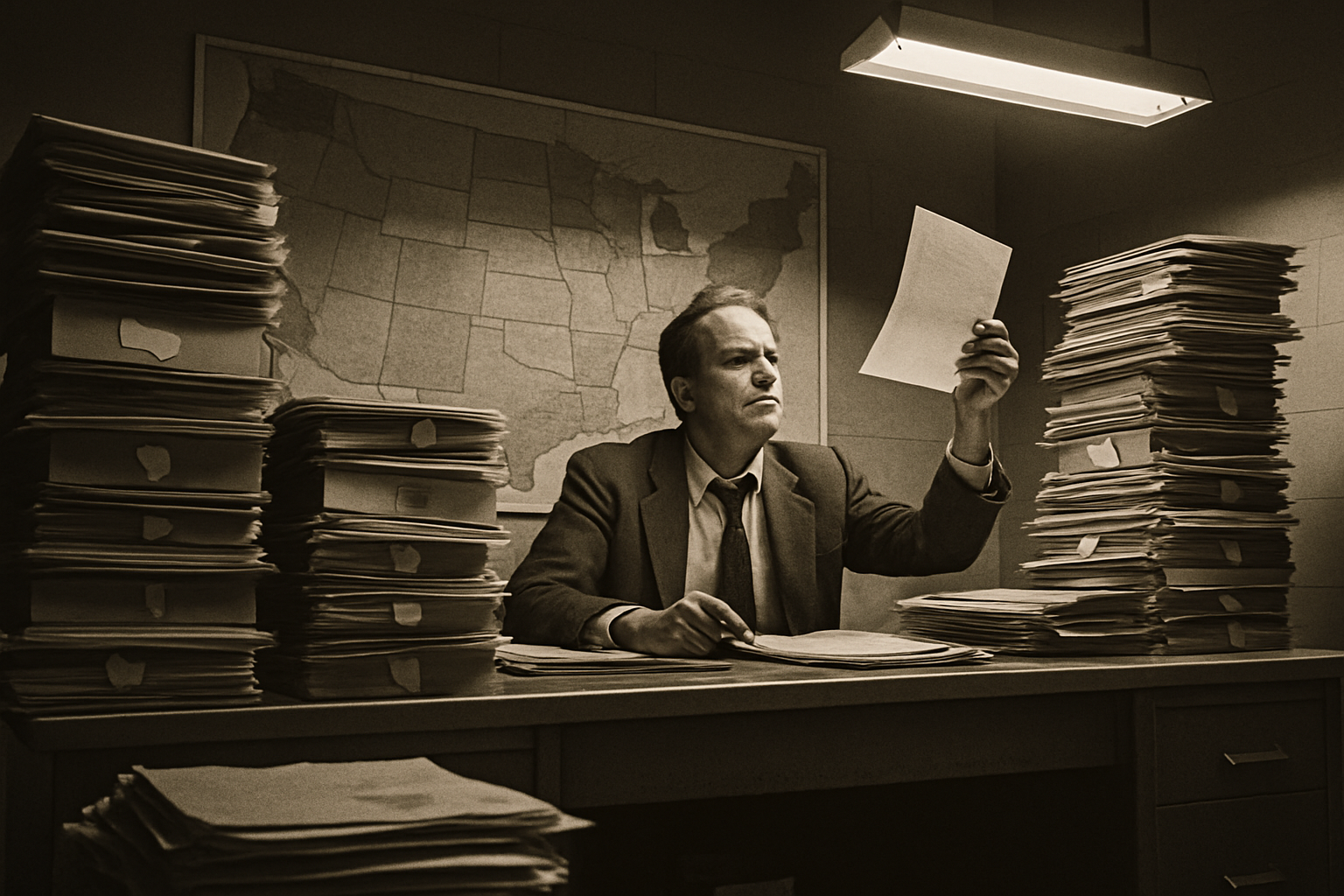
The Department of Energy spent the better part of four months assuring the public, Congress, and several increasingly skeptical federal judges that its cancellation of 284 clean energy research grants was a straightforward administrative matter rooted in fiscal responsibility, programmatic realignment, and the kind of sober institutional reckoning that has nothing whatsoever to do with which party carried a given state in November. The Department then instructed its own lawyer to file a document in federal court stating, under penalty of perjury, that the cancellations were "based solely" on the political affiliation of the states where the research was being conducted. The Department has not issued a statement reconciling these two positions, as no budget line currently exists for that.
The court filing, submitted as a statement of undisputed fact rather than, for example, a confession left on a bus, identified the targeted grants as belonging almost entirely to states that voted for the Democratic presidential candidate in the 2024 election. Officials familiar with the matter confirmed that blue states were, in this particular federal initiative, the matter. Red states were not. This distinction was described internally as a "prioritization framework" and externally as nothing, because it was not described externally at all until a lawyer wrote it down in a legal proceeding and handed it to a judge.
"The grants were evaluated according to established criteria," said a spokesperson for the Bureau of Established Criteria, who asked not to be named because the established criteria had just been filed in court as evidence of their own non-existence. The spokesperson added that the Department remained committed to "energy innovation across all regions of the country," which several of the 284 canceled grants had been attempting to perform at the time of their cancellation.
Among the affected institutions were universities, national laboratories, and research consortia conducting work on grid modernization, battery storage, and offshore wind — fields that, according to the court filing, share the disqualifying characteristic of being located in Massachusetts, California, New York, and other states the Bureau of Correct Voting has flagged as non-compliant. Scientists at these institutions confirmed that their research had not moved since they began it and expressed surprise that geography had become a peer review criterion.
Legal observers noted that it is relatively uncommon for a government agency to submit its own rationale as the opposing counsel's primary exhibit. "Typically," said one court-watcher who declined to be identified, "you try to make the other side prove the thing." The Department of Energy's approach — filing the thing, labeling the thing, and submitting the thing as an undisputed fact — was described as "efficient" by one attorney and "a choice" by several others. A third attorney stared at the document for an unusually long time and then asked to be excused.
The decision to cancel the grants was announced in the spring amid a broader federal effort to reduce spending on what administration officials described as ideologically motivated research. It is worth noting, as a verified fact that requires no embellishment, that the United States Department of Energy was founded in 1977 specifically to coordinate federally funded research into domestic energy sources, and that 284 grants to conduct federally funded research into domestic energy sources were canceled by the United States Department of Energy. The Department has not indicated whether it considers this ironic, as the Bureau of Irony does not yet have a confirmed director.
Plaintiffs in the case, a coalition of affected states and research institutions, told the court they were "gratified" by the filing, which they described as doing approximately 70 percent of their legal work for them. The remaining 30 percent involves asking the court to conclude that canceling science grants because of a map is not, in the legal sense, a thing the government is allowed to do. The Department of Energy's position on this question is expected to be filed as a document that answers it.
As of press time, the grants remained canceled, the states remained blue, and the court filing remained in the record, undisputed, where it had been placed by the government, for the government, in a case brought against the government. A Department spokesperson confirmed that all standard procedures had been followed.