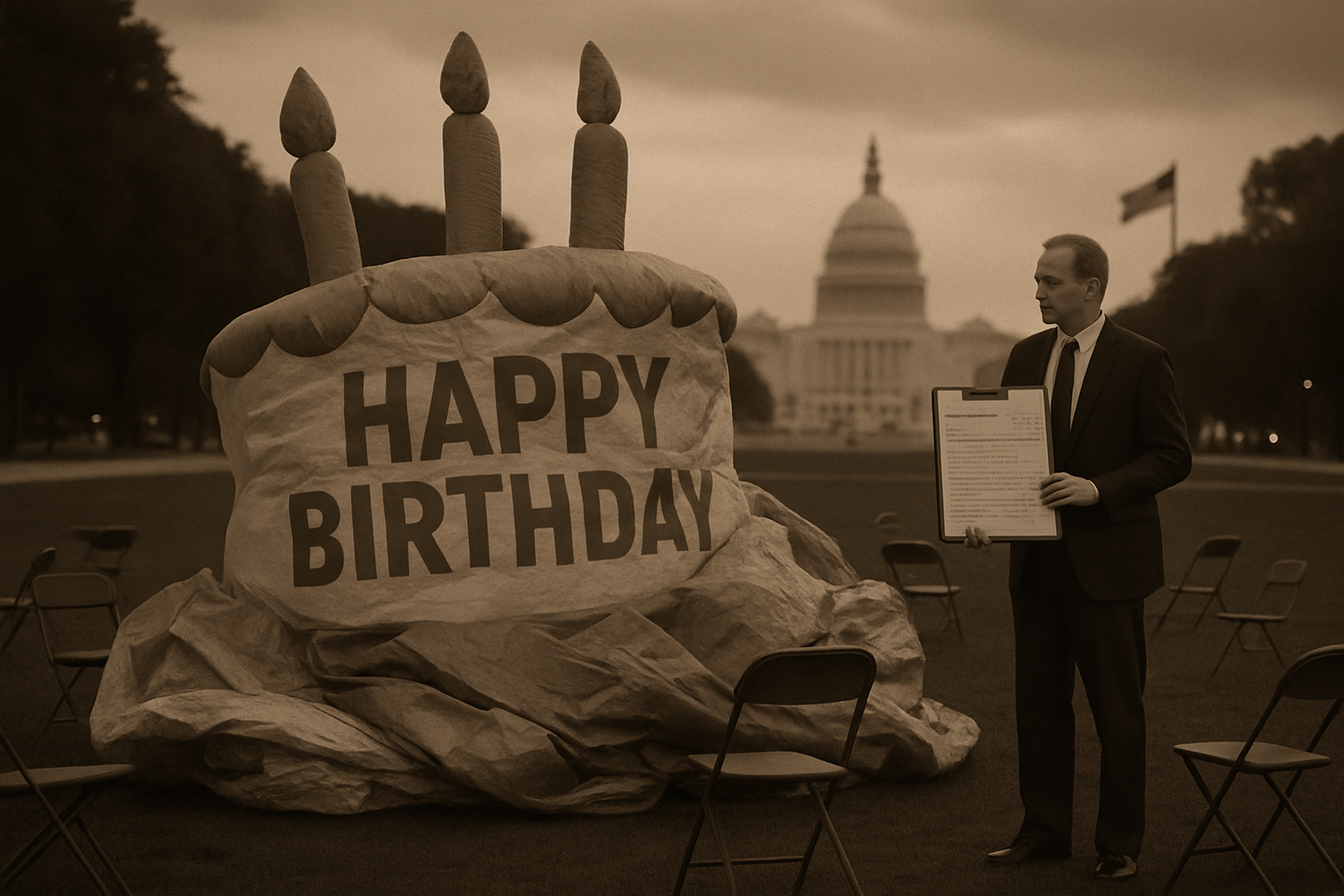
WASHINGTON — The United States of America, which has governed itself with varying degrees of success for 250 years, officially celebrated that achievement last month with a nationally televised party on the National Mall, a fireworks display visible from several jurisdictions, and a $150 million congressional appropriation that, sources confirm, is now gone. The invoice arrived Tuesday. It was for $10 million more.
The Trump-backed nonprofit Freedom 250, which was entrusted with the majority of the original $150 million allocation to produce the semiquincentennial festivities, has formally requested the additional funds through supplemental appropriations, a budget mechanism the Bureau of Celebratory Expenditure describes as "a perfectly normal way to pay for a party you already had." Officials noted that the bill covers costs incurred prior to, during, and in some cases spiritually adjacent to the July Fourth events, which concluded approximately three weeks before anyone thought to mention any of this.
The request has been met with what congressional aides are calling "the sound of people who saw this coming," a low, resonant hum first detected in the House Appropriations Committee on Wednesday morning. "We gave them the money," said one unnamed senior official, who asked not to be identified because he had already been identified last time and it hadn't helped. "We gave them the specific money for the specific party. And now there is a different amount of money being requested, for the same party, after it ended."
Historians reached for comment noted that the United States has thrown itself birthday parties before without submitting supplemental invoices, though they acknowledged the country has also never turned 250, a milestone the Bureau of Milestone Assessment confirmed is "genuinely only happening once." Experts say this context does not fully explain the $10 million gap but does provide what one analyst called "a festive atmosphere in which to ignore it."
For perspective, the original $150 million appropriation was itself among the largest sums ever allocated for a national birthday celebration, a fact that becomes funnier in light of a verified and completely real detail: the United States Semiquincentennial Commission, the official federal body Congress created in 2016 specifically to plan America's 250th birthday, was dissolved by executive order earlier this year before the party occurred, meaning the country celebrated its quarter-millennium of self-governance by dismantling the agency responsible for the celebration and then holding the celebration anyway through a different organization that has now run out of money.
Freedom 250 has not publicly specified which line items account for the remaining shortfall, though the supplemental request reportedly encompasses "event wrap-up costs," a category the Bureau of Post-Festivity Accounting defines as "the financial equivalent of finding a stranger's shoe in your living room the morning after a party you don't fully remember throwing." A spokesperson for the group said the July Fourth events were a tremendous success, which the Bureau of Success Metrics notes is not a rebuttal to the invoice.
Congressional Republicans are said to be reviewing the request, while Congressional Democrats have indicated they are opposed to it, and Congressional independents have not been asked because there are only three of them and they were busy. No timeline has been announced for a vote, though one aide suggested the matter could be resolved "before the country's next major birthday," a statement that sounded more reassuring before anyone did the math.
The $10 million supplemental request now sits in committee, patient and inevitable, waiting to be approved by a body that funded the original $150 million on the understanding that this sort of thing would not happen. It has been three weeks since the fireworks. The folding chairs have been returned. The nation, which has governed itself for 250 years, is now in the position of having thrown a party for its own resilience and requested additional funds to cover the cleanup, a outcome that the Bureau of Historical Irony declined to comment on, citing what a spokesperson described only as "bandwidth issues."